Cart
0
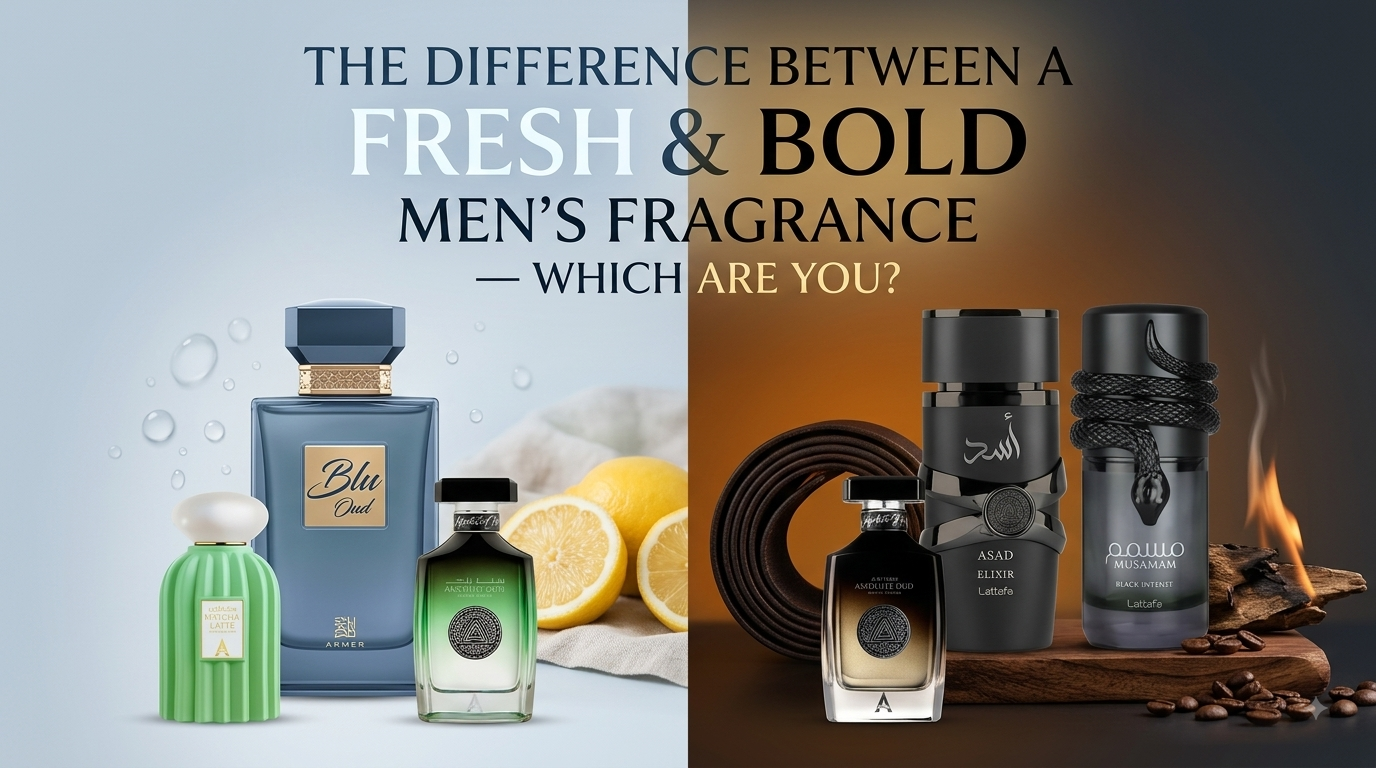
Ask any perfume counter assistant what you're looking for and you'll usually get the same two questions back: do you want something fresh, or something with more presence? It sounds like a simple choice, but it's actually the single biggest factor in whether a fragrance suits you — more important than the brand, the bottle, or even the price.
Here's what actually separates a "fresh" fragrance from a "bold" one, how to tell which camp you fall into, and which Arabic perfumes suit each style.
What Makes a Fragrance "Fresh"
Fresh fragrances are built around notes that read as clean, light, and energising. Think citrus (bergamot, lemon, grapefruit), aquatic and marine accords, green notes like fig leaf or mint, and light woods such as cedar or vetiver used sparingly rather than as the main event.
The goal of a fresh fragrance isn't to announce itself — it's to sit close to the skin and lift as you move. Sillage (how far a scent projects) is usually moderate, and longevity tends to be shorter than heavier compositions, which is part of the trade-off: freshness fades faster because the molecules that create it are lighter and evaporate quicker.
Fresh suits you if:
- You want to smell clean and put-together without anyone clocking that you're wearing perfume
- You're applying in the morning for an office or client-facing environment
- You live somewhere warm, or you're buying for spring/summer wear
- You find heavier scents give you a headache or feel like "too much" by midday
What Makes a Fragrance "Bold"
Bold fragrances lead with density and depth — oud, amber, dark musk, leather, incense, warm spice, and resinous notes like labdanum or benzoin. These are the compositions built to be felt in a room, not just up close. This is where a lot of Arabic perfumery naturally lives, because the traditional oil-based, high-concentration approach to fragrance was designed around richness and longevity rather than subtlety.
Bold doesn't mean overpowering by accident — a well-built bold fragrance is layered and complex, it just projects further and lasts longer than a fresh scent will. Two sprays of a genuinely bold Extrait de Parfum can outlast four sprays of a fresh EDT.
Bold suits you if:
- You want to be remembered — bold scents create a strong scent memory associated with you specifically
- You're wearing it for evenings, dates, or occasions where you want presence
- You run cold, or you're in autumn/winter where lighter scents evaporate almost instantly
- You already gravitate toward oud, amber, or leather notes when you read fragrance descriptions
The Real Answer: Most Men Are Both
Very few people are purely one or the other — most men have a fresh fragrance for the office and a bold one for evenings, and that's the smarter way to build a small collection rather than trying to find one scent that does everything. If you're only going to own one bottle right now though, think about where you spend more of your time: a 9-to-5 office environment leans fresh, a lifestyle with more evenings out or a job where you're not desk-bound leans bold.
It's also worth factoring in your natural body chemistry. Fragrance reads differently on drier skin (which tends to mute a scent and shorten its life) versus oilier skin (which can amplify projection and longevity). If you've ever bought a fragrance because a friend recommended it and found it barely lasted on you, skin type — not the perfume itself — is usually the reason.
Fresh Picks to Start With
If you're leaning fresh, look for scents with citrus or aquatic top notes and a light woody or musky base rather than a heavy oriental one. Within Arabic perfumery, fresher interpretations do exist — they usually sit in the "aromatic" or "citrus" fragrance families on product listings rather than "oriental" or "woody oud."
Bold Picks to Start With
If you're leaning bold, prioritise Extrait de Parfum or high-concentration EDPs over lighter EDTs, and look specifically for oud, amber, or leather listed in the base notes — that's where the depth and longevity actually comes from. Houses like Ahmed Al Maghribi and Dkhoni both carry strong bold-leaning ranges built around exactly these notes, so they're a solid starting point if presence is what you're after.
How to Test Which You Are
Don't rely on how a fragrance smells straight out of the bottle — spray it on skin, not paper, and give it 20–30 minutes to develop. The first five minutes are dominated by top notes, which can be misleading; a fragrance that opens fresh and citrusy can still dry down into something much bolder once the base notes emerge a couple of hours later. If you genuinely want to know your type, wear a few different scents for a full day each rather than judging from a single sniff at the counter.
Final Thoughts
There's no wrong answer between fresh and bold — it's about matching the fragrance to your lifestyle, the season, and the impression you actually want to leave. If you're building out a small rotation, one strong option in each category will cover you for almost every occasion you'll need a fragrance for.
Explore the full range of men's Arabic perfumes at Midnight Essence, and if you're deciding between specific houses, our Dkhoni vs Lattafa comparison is a good next read.
FAQ
Are Arabic perfumes always bold? Not always — while Arabic perfumery is best known for rich, oud-forward compositions, most houses also produce lighter, fresher options within their ranges. Check the fragrance family listed on the product page (aromatic/citrus vs oriental/woody) to know which you're getting.
Does a bold fragrance always last longer than a fresh one? Generally yes, because bold fragrances are built on heavier, slower-evaporating molecules like amber and musk, and are usually formulated at a higher concentration (EDP or Extrait) than fresher scents.
Can I wear a bold fragrance in summer? You can, but heat intensifies projection, so it's worth applying fewer sprays than you would in winter to avoid it becoming overpowering.
What's the best way to test if a fragrance suits me? Spray on skin rather than paper, and wait at least 20–30 minutes before judging — the scent you smell immediately after spraying is not the scent you'll be wearing for most of the day.